Special Moments
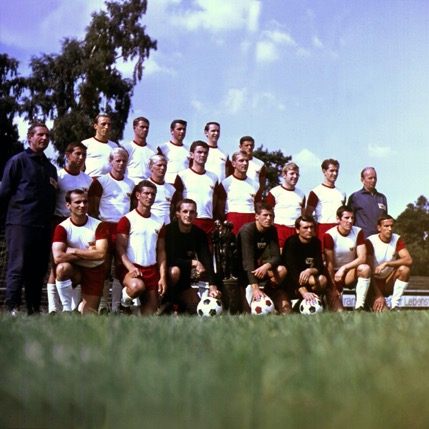
On June 9, 1968, one of the greatest sensations in GDR football took place at the Kurt-Wabbel-Stadion in Halle. 13,000 spectators witnessed how the freshly crowned champions FC Carl Zeiss Jena — a week after the end of the season — faced the underdog from Köpenick, 1. FC Union Berlin, in the 17th FDGB-Pokal final as overwhelming favourites. The Berliners had finished the championship 14 points behind Jena in eighth place. During the season, Jena had beaten Union 3-0 at home. In Berlin, it ended goalless.
Almost everything pointed towards Jena, for whom it was already their third FDGB-Pokal final appearance. Little pointed towards Union, who were contesting their first FDGB final. FC Carl Zeiss were particularly motivated, as they could become the first GDR team to achieve the double — champions and cup winners in one season. "Our opponents' ambition to achieve the double for the first time certainly doesn't make our task easier," Union coach Werner Schwenzfeier was quoted in the "Neue Fußballwoche."
But perhaps the Thuringians didn't take the final game of the season too seriously after all. The team was already heading to Kölpinsee on the Baltic island of Usedom just two hours after the final whistle, where family members had been gathered for days. Extra time or even a defeat were not part of the plan.
But when referee Rudi Glöckner blew the final whistle, it was the underdog from Köpenick whose players threw their arms in the air. They had beaten the Goliath from Jena 2-1 (1-1) in thoroughly deserved fashion. "The cup final was unfortunately our worst game of the season. We couldn't handle the favourite's role," Jena coach Georg Buschner explained. "On top of that, there was the lightning goal for us after 30 seconds. As bizarre as it sounds, it was poison for our team."
Werner Krauß's 1-0 was virtually the only moment that went according to plan for the champions. Union surprised everyone simply with the selection of young defender Reinhard Lauck, who just 21 days earlier had played for Energie Cottbus at Vorwärts Stralsund (1-1) on the final DDR-Liga matchday. In the quarter-final in the spring of 1968, Lauck had even played against Union. It finished 1-1 in Cottbus. Union won the replay 1-0. Lauck was actually a new signing for the 1968/69 season. The fact that he featured in the final of the preceding season is one of those curiosities of GDR football.
In the final, the relatively swift penalty equaliser from Meinhard Uentz after 29 minutes gave the underdog courage — a team that was already qualified for European competition even in the event of defeat. "FC Carl Zeiss Jena were visibly surprised by the quality of our eleven's play," Union captain Ulrich Prüfke later told the "Neue Fußballwoche." His coach Werner Schwenzfeier went further: "We dominated the champions before half-time with superior footballing means. After the break, we remained dangerous throughout with our trademark counter-attacks."
Ralf Quest scored the 2-1 after 63 minutes. Goalkeeper Rainer Ignaczak kept a clean sheet from then on. The more than 1,000 Union fans who had arrived by car and a special train enthusiastically waved their flags. The newspapers also honoured the sensation. "Crowning conclusion to a successful season" was the headline in the "Berliner Zeitung." "No dream: Union are cup winners" appeared on page 1 of the "Berliner Fußball" supplement in the "Neue Fußballwoche."
Lord Mayor Herbert Fechner presented the players at the Red Town Hall the day after the final with a Meissen porcelain plaque depicting the Red Town Hall. "We signed the 'Golden Book' of the city. Then the Lord Mayor invited us to the window," recalled the then second club secretary Günter Mielis. "In front of the Red Town Hall, a new tour bus awaited us. In large letters, the inscription 1. FC Union Berlin shone out at us."
Union did not play in the European Cup despite being drawn against Yugoslav side FK Bor on July 10, 1968 in Geneva for the first round of the Cup Winners' Cup. Dark clouds gathered in the night of August 21, 1968. Around 500,000 soldiers from the Soviet Union, Poland, Hungary and Bulgaria marched into the reform-minded Czechoslovak Socialist Republic. The "Prague Spring" was ended by force of arms. In early September 1968, the political crisis also reached UEFA.
AC Milan, FC Zürich and Celtic Glasgow refused to play their initially drawn socialist opponents Levski Sofia, Dynamo Kyiv and Ferencváros Budapest in the European Cup because of the invasion by Warsaw Pact troops in Prague. UEFA's Emergency Committee consequently ordered a series of (unconstitutional) redraws in both the European Cup and the Cup Winners' Cup.
In the first round, eastern and western European clubs were to be kept apart. Champions Jena retained their draw of Red Star Belgrade; cup winners Union were now to face Dynamo Moscow. Now, in addition to the GDR's German Football Association (DFV), the football associations of the USSR, Hungary, Poland, Bulgaria and France also protested against the redraw. When UEFA stood by its revised fixtures in a further vote on September 9, 1968, the DFV Presidium threatened in a telegram on September 13, 1968 to withdraw Jena and Union. When no further response came from UEFA, the boycott of the GDR representatives was confirmed. The clubs from the Soviet Union, Hungary, Poland and Bulgaria likewise did not send their champions and cup winners.
The victory over Jena remains special despite this sore point. The significance of the triumph is all the greater given that, until 2019, it remained the only national title Union Berlin had won after the Second World War. In the days before the 2001 DFB-Pokal final between Schalke 04 and Union (2-0), the then Union president Heiner Bertram said that when looking back at Union's past, 1968 was the "only positive exception."