OMG — Oh My God
Union Berlin and money! Since German reunification, Union Berlin has repeatedly struggled with financial problems. Once, a piece of fraud even cost them promotion, and at some point millions from the "Kinowelt" empire had to come to the rescue. But "Die Eisernen" could always rely on their loyal fans, even in the worst of times. Down to the last drop of blood…
The man with the money suitcase: In January 1998, Union gained a prominent supporter. Karlsruhe-based media entrepreneur Dr. Michael Kölmel ("Kinowelt") had made it his mission to help financially stricken traditional clubs. Generous or shrewd? That is in the eye of the beholder. In total, he invested 65 million euros in various football clubs — Union was his first patient. When he announced the financial restructuring alongside Union president Heiner Bertram, the Berlin club boss had tears in his eyes. Thanks to Kölmel ("You need a long breath in this business"), Union became debt-free, assigned its TV rights to Kölmel and initiated an image transformation. But had exactly what Nina Hagen denies in the club anthem ("Eisern Union") come to pass? "Who refuses to be bought by the West? — Eisern Union!" Or had they…?
"Bleeding for Union": Dr. Kölmel's financial windfall eventually dried up. When the club plummeted to the Oberliga in 2005, Kölmel had already received a suspended sentence for delay of insolvency proceedings… Union again faced ruin at the end of the 2003/04 season. With the blood donation campaign "Bleeding for Union" in May and June 2004, fans raised money and helped gather the 1.46 million euros needed for short-term survival. The rest was contributed by club chairman Zingler, Kölmel and other sponsors. The consolidation succeeded. Under new coach Christian Schreier, promotion back to the Regionalliga was achieved.
The forged bank guarantee: The biggest financial thriller involving the Köpenickers played out in the capital in 1993. Sportingly, Union Berlin had "finally" qualified for the 2. Bundesliga — 1-0 in the relegation match against Bischofswerdaer FV 08! It subsequently emerged that the bank guarantee required for licensing was forged. On July 2, 1993, the DFB awarded the second-division spot to the despised West Berlin rivals Tennis Borussia Berlin. As the Berliner Tagesspiegel later reported, an employee of Union's main sponsor allegedly tipped off TeBe's boss and hit producer Jack White (alias Horst Nußbaum). Jack White ("Heute haun' wir auf die Pauke") gratefully accepted the information. Nevertheless, it has never been definitively established who leaked this inside information to the DFB. DER SPIEGEL saw "a touch of Mielke" in July 1993 — an East Berlin football farce that Stasi boss Erich Mielke probably couldn't have staged any better: "The gentlemen of the football club Union Berlin find only short-lived comfort in the 27 verses that an 'anonymous folk poet' has nailed to the notice board at the offices in Köpenick. As in the best days of the peaceful revolution, the entire misery of the east is captured in doggerel: 'No matter how often our lads hit the net / the Wessis still do the deal!'" In any event: at the end of the 1993/94 season, Union Berlin were once again denied a second-division licence — the "lack of economic viability" hadn't changed. A debt mountain of 2.56 million euros made the DFB balk. The most valuable players, such as future World Cup runner-up Marko Rehmer and Bosnian Sergej Barbarez, had to be sold to avoid sinking even deeper into the red. Coach Frank Pagelsdorf left Berlin, joined Hansa Rostock — and won promotion to the Bundesliga with the Mecklenburg club…
Deep in trouble — The scandal professional: No other player has irked 1. FC Union more than Nico "Patsche" Patschinski. The native East Berliner apparently had a rather idiosyncratic relationship with money during his time at "Die Eisernen" from 2006, and possibly beyond. "What I do with my cash is my business. Whether I wipe my arse with it, gamble it or burn it. It's only money," he countered critics who had regarded him as a gambling addict since at least 2007. Patschinski, at 10,000 euros a month the top earner at Wuhlheide, wouldn't be Patschinski if he didn't play down the problem. "Union's sporting director Christian Beeck said in 2007 that I was addicted to gambling and sick, that I wasn't performing. By that point I'd already had myself banned from all casinos because I'd lost too much — but I wasn't a gambling addict then and I'm not now. I just played a bit of cards and placed some bets," he told the Berliner Kurier in March 2016. His participation in a charity poker tournament organised by hated East Berlin rivals BFC Dynamo earned him a formal warning and a 5,000-euro fine. Anti-Union slogans and a wild party night with Dynamo were enough for the club to dismiss Patschinski without notice for "conduct damaging to the club." When his contract was finally dissolved in July 2009 after lengthy wrangling and a severance payment of around 130,000 euros became due, Union president Dirk Zingler breathed a sigh of relief: "We're glad this chapter is closed."
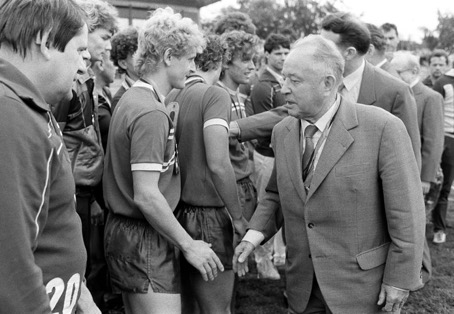
"Prague Spring" prevents European debut: Somehow, Union always had bad luck in the old days. The legendary 1968 GDR cup triumph was supposed to be followed at last by a European debut. Then the military suppression of the "Prague Spring" got in the way for the "Schlosserjungs," as the Union players were also known. The European Cup draw against the Yugoslav club FC Bor was annulled, and when the Western clubs pushed for a redraw, Dynamo Moscow — the Lev Yashin club — landed in the draw for the Berliners. Now the Eastern European clubs had had enough and withdrew their teams from the competition — the GDR followed suit. "That was of course a huge disappointment," Werner Schwenzfeier (1925–1995) recalled later. "The 15,000 tickets lasted Union as scrap paper for three years."