Good to Know
"Eisern Union" has been around for quite some time: Union Berlin enjoys cult status far beyond the football scene and the city limits of Berlin. Like hardly any other club from the former GDR, Union cultivates the image of a "workers' club" — with a lovably eccentric aura and a dash of Ostalgie. The battle cry of Union Berlin fans, like the title of the club anthem sung by Nina Hagen, is "Eisern Union" ("Iron Union"). That much is widely known. Less well known is that the battle cry is almost 100 years old, dating back to the 1920s or 1930s. Many fans and players of the predecessor club SC Union Oberschöneweide worked in industrial plants in the Berlin district of Oberschöneweide after the First World War. Since the early 20th century, this had been an industrial cluster of up to 25 large enterprises and a multitude of small workshops and laboratories — primarily in the electrical, metalworking and mechanical engineering industries. The Oberspree power station was the first major power plant outside Berlin and the first three-phase power plant in the German Reich — a pioneer of modern electricity generation, as it was the first to feed electrical energy into a supply grid. During the First World War, Oberschöneweide became a key centre of the armaments industry. The high number of workers turned the district into a centre of the working class. The labour in those industrial plants was typically extremely hard and physically demanding, requiring an iron will and endurance to survive. A martial, metallic battle cry reflecting the industrial flair was therefore a natural fit for supporting the local football club — especially as Union apparently already cultivated a particularly athletic style of play at the time, the very opposite of the Schalke Spinning Top or the Viennese School. Urban legend has it that the battle cry was first heard during a match against Hertha BSC, when a draw against the clearly superior Herthaner threatened to slip away. According to other sources, the cry goes back to the nickname "Schlosserjungs" ("locksmith lads"). That's what the Union players were called because of their blue kit and their working-class origins before 1933.
Apolitical proletarians, hippies, hooligans and assorted "ideological misfits" sing anarchic songs: During the GDR era, apolitical proles, hippies, hooligans and assorted "ideological misfits" flocked to Union. The club was a counter-model to the two other Berlin clubs — BFC Dynamo Berlin and the initially GDR-football-dominating and later to Frankfurt/Oder-relocated ASK Vorwärts Berlin (FC Vorwärts from 1966). Union fans sang songs like: "Better to be a loser than a stupid Stasi pig." That is also known in the West. What is less well known? The anarchic mix of underdog feeling and defiance towards any form of state authority still shapes the Union fan scene today. A classic Union chant that emerged in the early 2000s and is still sung with gusto documents this: "Father died in prison / Mother lies deathly ill in bed / Sister became a whore / What am I to do alone in this world / Union, Union above all else / Germany's most immortal team / For Union will never fall apart / Iron Union from Berlin."
Union vs. BFC Dynamo, Tennis Borussia and Hertha BSC: The fan scene of Union Berlin has maintained fierce and well-known rivalries within Berlin, particularly with the "Stasi club" BFC Dynamo and, in the 1990s, with the "class enemy" Tennis Borussia Berlin from Charlottenburg. Less well known are individual details of the hostility and a very special relationship with a third club — Hertha BSC. For many old-school Union fans, the main enemy still stands in the east. Even though BFC Dynamo and Union Berlin have long since ceased to meet at eye level. Dynamo kicked around in the Regionalliga in 2019/20 while Union played in the Bundesliga. In GDR times, things were very different, and BFC Dynamo regularly thrashed the Köpenickers. What few people know today: between 1976 and 1989, there were no home derbies between Dynamo and Union. For "security reasons," all local derbies took place at the Stadion der Weltjugend in the city centre on neutral ground. The exception was the cup quarter-final Union vs. BFC in December 1988. But even that didn't help the Köpenickers. They lost 0-2 in front of 20,000 fans at the Alte Försterei.
After reunification, Tennis Borussia became the new hate object: The Köpenickers maintained an irreconcilable enmity with the club from Charlottenburg, once run or supported by TV presenter Hans Rosenthal and music producer Jack White. What few know: one of TeBe's most flamboyant players provided a particularly provocative moment. Ansgar Brinkmann, the former Osnabrücker, dared to enter the Alte Försterei stadium during the first relegation match in May 2000 between Union and VfL Osnabrück, was abused and threatened with a beating. "What's he doing here, we're a workers' club" was about the mildest reaction towards "Drinkmann."
If you have football enemies in the city, you also need some friends: Quite unknown is the fact that during the Wall years, fans of Hertha BSC and Union Berlin harboured considerable sympathies for each other. And they expressed it, as Berlin landlubbers with waterfront access — one lot in the far west, the other in the far east of the city — as follows: "We stick together like the wind and the sea — the blue-and-white Hertha and FC Union." Urban legend has it that cult Hertha fan Pepe Mager even sewed his own patches documenting the friendship between both teams during the Wall era. Since then, the sympathy between Hertha and Union fans has turned to antipathy. The reason? The top-dog syndrome, the Highlander attitude! There can be only one! Tennis Borussia and BFC Dynamo have long ceased to be rivals at eye level for Union Berlin. Rather footballing prey. But Hertha BSC presents itself as the perfect antithesis to "Die Eisernen." The two Berlin Bundesliga clubs could hardly be more different. Hertha BSC, with Lars Windhorst as investor and Jürgen Klinsmann — who fled Berlin again ad hoc in February 2020 — on the supervisory board (and as coach for 76 days…), desperately wants to be seen as a metropolis club and the number one capital-city club of the largest country in the European Union. Union positions itself as an ambitious neighbourhood club from the east with heart, warmth and soul. Successfully: Hertha had more members as of November 2019 (37,000) but not as many fans in the east of the city (though somewhat more in Brandenburg). Union is growing much faster and, with more than 32,000 members, has only about 15% fewer members than Hertha BSC. On top of that, the club develops cult potential similar to FC St. Pauli — in its own unique way and not limited to eastern Germany. Union stands more for a kind of new-old Berlin, while Hertha BSC keeps being associated with the very old West Berlin (You are leaving the functioning sector of Germany). With nonsensical spending, below-average management abilities and misplaced hubris — precisely what Jürgen Klinsmann recorded in his 22-page "diary" in 2019/2020 after quitting Hertha BSC…
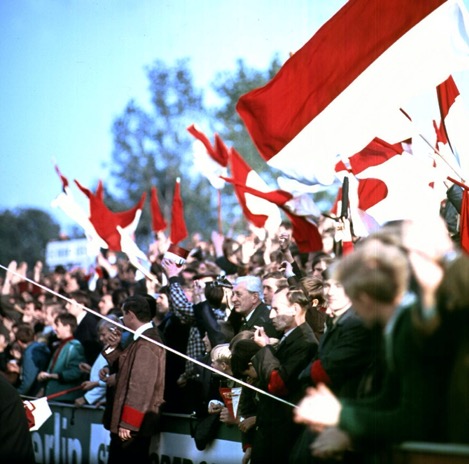
What few people outside Berlin know: there isn't just one Union Berlin, but two. And the Hertha icon Johannes Sobek played a key role. The reason is, once again, ideological. (We mentioned it briefly, but now in more detail.) In 1949, the German Sports Committee (DS), the sports umbrella organisation of the Soviet Occupation Zone, refused to accept the introduction of the contract player statute by the newly founded West Berlin Football Association for the city league, and pulled Union out of the city league for the following season. In protest and anger, the Oberschöneweide players played their remaining home matches of the current season at the Poststadion in Moabit. The team was coached by Hertha icon Johannes Sobek and, as runners-up, qualified for the German championship final round. The political leadership in the east, however, forbade them from travelling to Kiel for the match against HSV. In response, almost the entire first team defected to the West — and played against HSV! Two weeks later, on June 9, 1950, they founded SC Union 06 Berlin in the Moabit district of West Berlin. The "twin" from Moabit was considerably more successful in the early years after its founding than the original Union in Oberschöneweide. Only in the late 1950s and early 1960s did the club lose its foothold at the top of West Berlin football and fade into a purely amateur club. Incidentally: in March 1952, a "brotherly duel" took place in front of 20,000 spectators at the Walter-Ulbricht-Stadion. The now-BSG Motor Oberschöneweide "East Unionists" lost 0-2 to the "West Unionists."