Prologue
What this site is — and why
"AKTE UNION" is for lovers and haters of Die Eisernen alike. History becomes legend, legend becomes myth. And myth becomes cult — or a reason for eternal second-hand embarrassment, depending on the event.
Betrayed by the "class enemy," dissed by the "class friend." Union Berlin is the club that survived the GDR, survived reunification, and finally arrived in the Bundesliga in 2019 — only to promptly conquer Europe. The Alte Försterei in Köpenick is cult, the fans built their stadium with their own hands, and the rise from East Berlin outsider to Conference League participant is one of the great stories of German football.
But this site goes beyond mere celebration or hatred. Akte Union is structured in three parts: The Club Dossier tells the story — triumphs, tragedies, scandals, heroes and failures across 12 chapters. Match Intelligence delivers the live data a professional needs: squad, statistics, head-to-head, injuries, form. And Predictions brings it all together — with prediction markets.
Prediction markets are not gambling. In traditional sports betting, the masses lose — the money goes to the bookmaker who has built in his margin. Betting exchanges are similar: commissions on winnings, liquidity shortages and spread eat into returns. Prediction markets work fundamentally differently. There is no bookmaker who lets the house win. Instead, money flows from those who don't know to those who get it right — with risk management, portfolio diversification and disciplined capital deployment. You can trade 24/7, build and close positions, and wait for the binary resolution of the event. Those who understand it are not speculating — they're engaged in systematic trading.
Akte Union is part of Akte Bundesliga — the same concept for all 18 Bundesliga clubs. Each club gets its own dossier, its own intelligence, its own predictions. The big picture can be found at aktebundesliga.net.
Profile
Facts, figures and milestones
Profile — Facts, Figures and Milestones
1. FC Union Berlin (officially: 1. Fußballclub Union Berlin e. V.) is a football club based in Berlin-Köpenick. Its founding history is complicated. In 1906, in Luisenstraße (today's Plönzeile), ball boys and friends of the local club Excelsior gathered in a sandpit behind the Oberschöneweide school and founded the football club Olympia. The club dissolved shortly after, but some football enthusiasts from the same circle soon formed a new club, modelled on the neighbouring Lichtenberger S.C. Frisch Auf. Excelsior split into Preußen and Vorwärts, but neither offshoot lasted long.
Ultimately, members of all three clubs came together and on June 17, 1906, founded Olympia Oberschöneweide at the "Großkopf" tavern in Luisenstraße 17. The team initially consisted almost entirely of schoolboys and joined BTuFC Helgoland 1897 as a youth team barely a month later. The club was not very successful, so the Oberschöneweide players decided to switch again just six months later. This time they attached themselves to the 1905 German Football Champions — BTuFC Union 1892. There the team played for two years — albeit only as the fourth team. In the 1907/08 season, they achieved their first modest success by winning the championship of the lowest division of the Berlin Ball Sports Association (VBB). In February 1909, the team separated from BTuFC. They wanted to stand on their own feet. Out of gratitude and loyalty, they adopted both the name (henceforth calling themselves Union Oberschöneweide, later with the prefix SC) and the club colours blue and white.
Three years later, in the 1909/10 season, the Berliners first competed as an independent club in the VBB — quite successfully. After three promotions in five years, the club played in Berlin and Brandenburg's top division from 1914. In the new league of the Brandenburg Ball Sports Association, Union even became runners-up in 1917.
The team played for nearly ten years at a sports ground on Wattstraße in Oberschöneweide, until the 1920 move to the Sadowa sports complex — today's Stadion An der Alten Försterei — in the Wuhlheide forest. For the official opening ceremony on August 7, 1920, the reigning German champions 1. FC Nürnberg visited. In 1920, Union became Berlin champions for the first time and qualified for the German championship final round. They reached the quarter-finals and narrowly lost 2-3 to Vereinigte Breslauer Sportfreunde. In 1923, the club became Berlin champions again and, after victories over Arminia Bielefeld and SpVgg Fürth, made it all the way to the championship final. At the Grunewald Stadium in Berlin, Union lost their "home match" 0-3 against Hamburger SV in front of 64,000 spectators. The early heyday of "Union-Ob." — as fans called the club — came to an end.
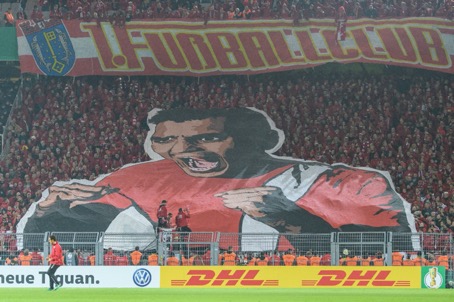
The 1925 runner-up spot in Berlin and reaching the Berlin Cup final in 1926 were the only other significant achievements. From then on, clubs like Hertha BSC or Tennis Borussia Berlin dominated Berlin football. After the Second World War, the club initially continued as the communal sports group SG Oberschöneweide. In 1948, it was transformed into SG Union Oberschöneweide. And the club thrived — qualifying for the 1949 German Championship final round, only to be forbidden from travelling to Kiel for the match against HSV. In response, virtually the entire first team defected to West Berlin and left Union. The club changed its name in the GDR to BSG Motor Oberschöneweide and was incorporated into the VEB Transformatorenwerk Karl Liebknecht as a factory sports group. Until 1962, the club played predominantly in the GDR's third division. Only in the 1965/66 season did they earn promotion to the DDR-Oberliga.
The club benefited from politics in this regard. Herbert Warnke, chairman of the FDGB (Free German Trade Union Federation), demanded that a civilian football club be established for Berlin's working people. He succeeded. On January 20, 1966, "1. FC Union Berlin" was newly founded.
Good to Know
What few people know
"Eisern Union" has been around for quite some time: Union Berlin enjoys cult status far beyond the football scene and the city limits of Berlin. Like hardly any other club from the former GDR, Union cultivates the image of a "workers' club" — with a lovably eccentric aura and a dash of Ostalgie. The battle cry of Union Berlin fans, like the title of the club anthem sung by Nina Hagen, is "Eisern Union" ("Iron Union"). That much is widely known. Less well known is that the battle cry is almost 100 years old, dating back to the 1920s or 1930s. Many fans and players of the predecessor club SC Union Oberschöneweide worked in industrial plants in the Berlin district of Oberschöneweide after the First World War. Since the early 20th century, this had been an industrial cluster of up to 25 large enterprises and a multitude of small workshops and laboratories — primarily in the electrical, metalworking and mechanical engineering industries. The Oberspree power station was the first major power plant outside Berlin and the first three-phase power plant in the German Reich — a pioneer of modern electricity generation, as it was the first to feed electrical energy into a supply grid. During the First World War, Oberschöneweide became a key centre of the armaments industry. The high number of workers turned the district into a centre of the working class. The labour in those industrial plants was typically extremely hard and physically demanding, requiring an iron will and endurance to survive. A martial, metallic battle cry reflecting the industrial flair was therefore a natural fit for supporting the local football club — especially as Union apparently already cultivated a particularly athletic style of play at the time, the very opposite of the Schalke Spinning Top or the Viennese School. Urban legend has it that the battle cry was first heard during a match against Hertha BSC, when a draw against the clearly superior Herthaner threatened to slip away. According to other sources, the cry goes back to the nickname "Schlosserjungs" ("locksmith lads"). That's what the Union players were called because of their blue kit and their working-class origins before 1933.
Apolitical proletarians, hippies, hooligans and assorted "ideological misfits" sing anarchic songs: During the GDR era, apolitical proles, hippies, hooligans and assorted "ideological misfits" flocked to Union. The club was a counter-model to the two other Berlin clubs — BFC Dynamo Berlin and the initially GDR-football-dominating and later to Frankfurt/Oder-relocated ASK Vorwärts Berlin (FC Vorwärts from 1966). Union fans sang songs like: "Better to be a loser than a stupid Stasi pig." That is also known in the West. What is less well known? The anarchic mix of underdog feeling and defiance towards any form of state authority still shapes the Union fan scene today. A classic Union chant that emerged in the early 2000s and is still sung with gusto documents this: "Father died in prison / Mother lies deathly ill in bed / Sister became a whore / What am I to do alone in this world / Union, Union above all else / Germany's most immortal team / For Union will never fall apart / Iron Union from Berlin."
Union vs. BFC Dynamo, Tennis Borussia and Hertha BSC: The fan scene of Union Berlin has maintained fierce and well-known rivalries within Berlin, particularly with the "Stasi club" BFC Dynamo and, in the 1990s, with the "class enemy" Tennis Borussia Berlin from Charlottenburg. Less well known are individual details of the hostility and a very special relationship with a third club — Hertha BSC. For many old-school Union fans, the main enemy still stands in the east. Even though BFC Dynamo and Union Berlin have long since ceased to meet at eye level. Dynamo kicked around in the Regionalliga in 2019/20 while Union played in the Bundesliga. In GDR times, things were very different, and BFC Dynamo regularly thrashed the Köpenickers. What few people know today: between 1976 and 1989, there were no home derbies between Dynamo and Union. For "security reasons," all local derbies took place at the Stadion der Weltjugend in the city centre on neutral ground. The exception was the cup quarter-final Union vs. BFC in December 1988. But even that didn't help the Köpenickers. They lost 0-2 in front of 20,000 fans at the Alte Försterei.
After reunification, Tennis Borussia became the new hate object: The Köpenickers maintained an irreconcilable enmity with the club from Charlottenburg, once run or supported by TV presenter Hans Rosenthal and music producer Jack White. What few know: one of TeBe's most flamboyant players provided a particularly provocative moment. Ansgar Brinkmann, the former Osnabrücker, dared to enter the Alte Försterei stadium during the first relegation match in May 2000 between Union and VfL Osnabrück, was abused and threatened with a beating. "What's he doing here, we're a workers' club" was about the mildest reaction towards "Drinkmann."
If you have football enemies in the city, you also need some friends: Quite unknown is the fact that during the Wall years, fans of Hertha BSC and Union Berlin harboured considerable sympathies for each other. And they expressed it, as Berlin landlubbers with waterfront access — one lot in the far west, the other in the far east of the city — as follows: "We stick together like the wind and the sea — the blue-and-white Hertha and FC Union." Urban legend has it that cult Hertha fan Pepe Mager even sewed his own patches documenting the friendship between both teams during the Wall era. Since then, the sympathy between Hertha and Union fans has turned to antipathy. The reason? The top-dog syndrome, the Highlander attitude! There can be only one! Tennis Borussia and BFC Dynamo have long ceased to be rivals at eye level for Union Berlin. Rather footballing prey. But Hertha BSC presents itself as the perfect antithesis to "Die Eisernen." The two Berlin Bundesliga clubs could hardly be more different. Hertha BSC, with Lars Windhorst as investor and Jürgen Klinsmann — who fled Berlin again ad hoc in February 2020 — on the supervisory board (and as coach for 76 days…), desperately wants to be seen as a metropolis club and the number one capital-city club of the largest country in the European Union. Union positions itself as an ambitious neighbourhood club from the east with heart, warmth and soul. Successfully: Hertha had more members as of November 2019 (37,000) but not as many fans in the east of the city (though somewhat more in Brandenburg). Union is growing much faster and, with more than 32,000 members, has only about 15% fewer members than Hertha BSC. On top of that, the club develops cult potential similar to FC St. Pauli — in its own unique way and not limited to eastern Germany. Union stands more for a kind of new-old Berlin, while Hertha BSC keeps being associated with the very old West Berlin (You are leaving the functioning sector of Germany). With nonsensical spending, below-average management abilities and misplaced hubris — precisely what Jürgen Klinsmann recorded in his 22-page "diary" in 2019/2020 after quitting Hertha BSC…
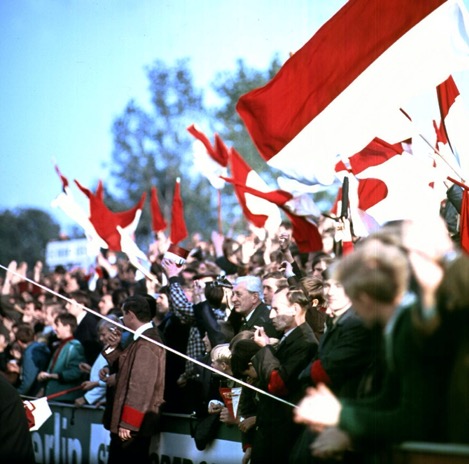
What few people outside Berlin know: there isn't just one Union Berlin, but two. And the Hertha icon Johannes Sobek played a key role. The reason is, once again, ideological. (We mentioned it briefly, but now in more detail.) In 1949, the German Sports Committee (DS), the sports umbrella organisation of the Soviet Occupation Zone, refused to accept the introduction of the contract player statute by the newly founded West Berlin Football Association for the city league, and pulled Union out of the city league for the following season. In protest and anger, the Oberschöneweide players played their remaining home matches of the current season at the Poststadion in Moabit. The team was coached by Hertha icon Johannes Sobek and, as runners-up, qualified for the German championship final round. The political leadership in the east, however, forbade them from travelling to Kiel for the match against HSV. In response, almost the entire first team defected to the West — and played against HSV! Two weeks later, on June 9, 1950, they founded SC Union 06 Berlin in the Moabit district of West Berlin. The "twin" from Moabit was considerably more successful in the early years after its founding than the original Union in Oberschöneweide. Only in the late 1950s and early 1960s did the club lose its foothold at the top of West Berlin football and fade into a purely amateur club. Incidentally: in March 1952, a "brotherly duel" took place in front of 20,000 spectators at the Walter-Ulbricht-Stadion. The now-BSG Motor Oberschöneweide "East Unionists" lost 0-2 to the "West Unionists."
For the Haters
Embarrassing disasters and major defeats
Heaviest competitive defeat: 1. FC Union Berlin's heaviest competitive defeat after German reunification in 1990 came on October 7, 2002 in the 2. Bundesliga — 0-7 at 1. FC Köln.
2-8 in Zwickau: A 2-8 from Union's perspective occurred in the 2. Bundesliga promotion round in 1992 at old DDR-Oberliga rivals FSV Zwickau.
0-5 against Werder Bremen: In the DFB-Pokal, eventual finalists Werder Bremen humiliated "Die Eisernen" 5-0 at the Alte Försterei on August 2, 2009.
Beatings from the Stasi club: Since the "Eisernen" were promoted in 1966, BFC Dynamo regularly dished out beatings to the Köpenickers in the DDR-Oberliga. In 1979/80, the Dynamos hammered Union 6-0; in 1986/87, even 8-1. In the FDGB-Pokal round of 16 in 1978/79, Union were thrashed both in the first leg (1-8) and the second leg (1-7).
The Unpromoteables: Union Berlin in the 2. Bundesliga promotion round — an unsolvable riddle! From 1992 onwards, the Unionists regularly missed out on promotion to Germany's "football basement." In 1992, it was five defeats in six matches against VfL Wolfsburg, FC Berlin (as BFC was temporarily named) and FSV Zwickau, with a goal difference of minus 15. In 1993, the Köpenickers were denied their second-division licence. Things turned dramatic in the summer of 2000. In a penalty shootout thriller in the relegation second leg at VfL Osnabrück (7-8) and the subsequent three-way playoff with LR Ahlen and SC Pfullendorf, the dream of the 2. Bundesliga remained unfulfilled once again.
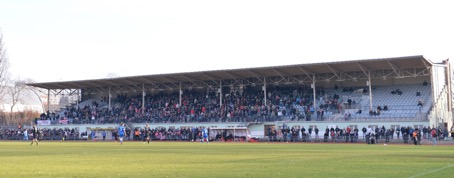
The painful premiere: Finally Bundesliga, finally with Union Berlin! The euphoria in Berlin on August 19, 2019 knew almost no bounds — but after a good half hour, it was already over. Opponents RB Leipzig showed Union how the Bundesliga works with two early goals, ultimately winning 4-0. There are certainly better premieres…
From a Union-hater perspective, the most enjoyable season was 2003/04 in the 2. Bundesliga. Even with coaching legend Aleksandar Ristic, who took over from Mirko Votava at the end of March, Union took a proper beating — and set several negative records.
Worst finishing position: 17th place in the 2003/04 2. Bundesliga season is the worst final result for 1. FC Union Berlin in either the 1st or 2nd Bundesliga.
Fewest points: In 2003/04, the Unionists collected just 33 points in the 2. Bundesliga. They fared even worse after reunification only outside the 2. Bundesliga — 27 points in the 2004/05 Regionalliga NORD season. Union were thus relegated for the second consecutive time.
For the Lovers
Key triumphs and major victories
Union Berlin's greatest achievements of the 21st century (as of December 2019) are the promotion to the Bundesliga in 2019 and reaching the DFB-Pokal final in 2001 in their own city.
The 2019 relegation playoff: By winning the 2019 relegation playoff against 16th-placed VfB Stuttgart, Union Berlin reached the German top flight for the first time and unleashed sheer pandemonium in the Wuhlheide. Remarkably, the club reached the Bundesliga in May 2019 with three consecutive draws. First, Urs Fischer's team came back from 0-2 down in Bochum. The 2-2 took them into the relegation playoff against VfB Stuttgart. With a 2-2 in Stuttgart and a 0-0 in Berlin, "Die Eisernen" made their fans' dream come true — and went up.
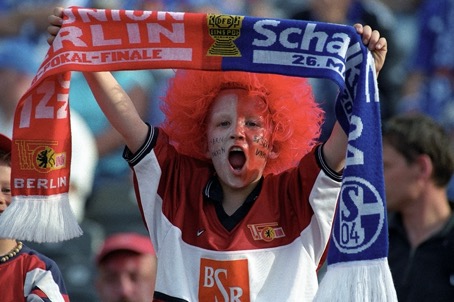
The year 2001: 2001 was, up to that point, the greatest year for 1. FC Union Berlin. The club was promoted to the 2. Bundesliga for the first time and, still a third-division side, reached the DFB-Pokal final in their own city against FC Schalke 04. Despite the 0-2 defeat to the Royal Blues, Union as cup finalists were finally eligible for the European Cup.
UEFA Cup: In the UEFA Cup, Georgi Vassilev's team beat the Finnish club Haka Valkeakoski 3-0 in the second leg. The first leg in the Finnish small town ended 1-1. The second leg on September 27, 2001 had a special twist — it had to be played at the Jahn-Stadion of arch-rivals BFC Dynamo, as the Alte Försterei was not approved for international matches.
Intercup winners 1985: Further international successes are thin on the ground. Most notably, in 1985 Union won the Intercup in a group with Bayer Uerdingen, Standard Liège and Lausanne Sports.
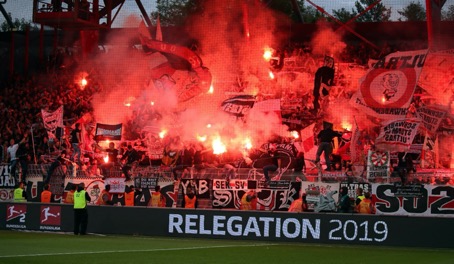
Giant-killer at Wuhlheide: The Alte Försterei quickly proved to be a giant-killing ground on the domestic front. In the 2000/01 season, all of German football got to know the Köpenick football cult venue, which until then had been familiar practically only to connoisseurs of east German football or Berlin specialists. That changed during the DFB-Pokal matches of that memorable season. In the tight stadium, where the scoreboard was still operated by hand and the pitch after snowfall for the semi-final resembled a Brandenburg field more than a competitive football ground, the perennial underdogs strung one victory after another together. The absolute highlight of the cup run — five consecutive home wins — was the semi-final against Borussia Mönchengladbach. A 6-4 penalty shootout win sealed Union Berlin's place in the final on February 6, 2001!
Derby wins against Hertha: Union Berlin and their big West Berlin neighbours Hertha BSC did not face each other in the Bundesliga until November 2019. Union won 1-0 through a late goal. In the 2. Bundesliga between 2010 and 2013, there were only four east-west derbies, of which the Köpenickers and Hertha each won one. On February 5, 2011, the Unionists triumphed 2-1 at the Olympiastadion in front of 74,244 spectators. John Jairo Mosquera and Torsten "Tusche" Mattuschka became derby heroes with their goals.
The first Bundesliga win: When mighty BVB visited the Wuhlheide on August 31, 2019, the roles were clearly defined. Dortmund wanted to become champions; Union hadn't won a single Bundesliga match yet. But the game didn't develop as expected. Union took the lead through Marius Bülter in the 22nd minute, BVB equalised through Paco Alcácer in the 25th. At half-time it was 1-1, but the Berliners came out more aggressive and sharper. Bülter again in the 50th minute and Sebastian Andersson in the 75th struck against the Black and Yellows to deliver Union Berlin's first-ever Bundesliga win.
Union outsmarts Buschner: A 2-1 victory over FC Carl Zeiss Jena in the 1968 FDGB-Pokal final — rated as sensational by GDR standards — brought Union Berlin their only national title. Union coach Werner "Schwenne" Schwenzfeier outsmarted Jena and their coach, later GDR national team manager Georg Buschner, by pulling the 21-year-old rookie Reinhard "Mäcki" Lauck out of the hat. Lauck himself was completely surprised by his selection: "Schwenzfeier must have gone mad!" Not quite. It was a line-up that caught the favourites off guard — Union won 2-1 through goals from Meinhard Uentz and Ralf Quest. "Mäcki" Lauck won the football gold medal at the 1976 Olympics in Montreal with the GDR. More on this very special Union moment and the drama that followed the FDGB-Pokal triumph in the Special Moment section a few pages later.
Most Important Persons
The men who shaped the club
The promotion coach: As of December 2019, Uwe Neuhaus is Union's record-holding manager. For seven years, from 2007 to 2014, the "Wessi" born in 1959 sat on the sideline at Union. No head coach in the club's 53-year history has served longer in one stretch…
The successful big man: For two years, the Hanoverian steered the fortunes at Union Berlin. In the 1992/93 season, the heavyweight was appointed head coach of the later "Unpromoteables," who at that point were playing in the NOFV-Oberliga Mitte. For the fans, the second-division dream seemed…
The elegant technician: An absolute fan favourite and identification figure of the club. The Union fans strike up the "Torsten Mattuschka" song whenever there's a free kick or penalty for Union. The Cottbus-born player pulled on the red-and-white shirt 299 times and buried the ball 70 times…
The shrewd president: Since July 1, 2004, Dirk Zingler has been president of 1. FC Union. The club chairman has led the club all the way to the Bundesliga — including setbacks like the first-ever relegation to the fourth tier in 2005. The logistics entrepreneur has stubbornly fought for the football venue in the Alte Försterei…
The promotion fisherman: The Swiss success coach has more than earned his beer showers and celebrations in Berlin. Under Fischer, Union fans witnessed the greatest achievement in the club's 53-year history in May 2019: the Swiss led the club of underdogs to the Bundesliga for the very first time…
The cup winner: Werner "Schwenne" Schwenzfeier was a player for Union's predecessor club BSG Motor Oberschöneweide from 1954 to 1959. From 1965 to 1969, he coached Union Berlin. He led Union to promotion to the DDR-Oberliga and, in 1968, to victory in the FDGB-Pokal final against Carl Zeiss Jena…
Personae Non Gratae
The men fans love to hate
The dark side of the force: As a supporter and backer of BFC Dynamo, Erich Mielke has always been an abomination to Union fans — and not just for sporting reasons. The BFC, long regarded as the ultimate enemy, was not only GDR serial champions but also the favourite club of the Stasi chief, who represented everything…
The traitor: In June 1993, Union Berlin beat Tennis Borussia Berlin 2-1, all but sealing their sporting promotion to the 2. Bundesliga. After a 1-0 win against Bischofswerda, "Die Eisernen" were already planning their future as a professional club in a haze of celebration — when the "bombshell" dropped…
Tragic
Those who suffered misfortune
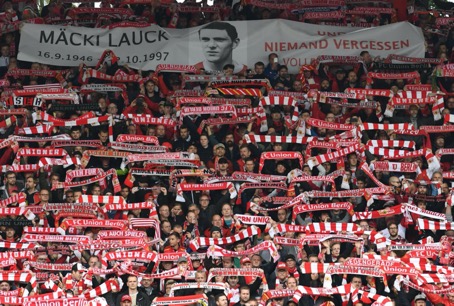
Reinhard Lauck — Alcohol: The most famous wanderer between the worlds of Union and BFC Dynamo is the former GDR national defender Reinhard Lauck. In 1974, in the GDR's sensational 1-0 win over the eventual World Champions West Germany, Lauck reduced Wolfgang Overath and Günter Netzer to bit-part players. Two years later, he became an Olympic champion in Montreal. Twenty-one years after that, Lauck died from the consequences of his alcoholism. His tragedy was poignantly told by Alexander Osang in his reportage "Ick bin doch Mäcki, kennste ma nich?" ("I'm Mäcki, don't you know me?").
Günter "Jimmy" Hoge — Anything but conformist: Günter "Jimmy" Hoge was Union Berlin's first GDR international. From 1958 to 1962, he played for ASK Vorwärts Berlin, then moved to BSG Motor Köpenick (1962–1964) and TSC Berlin (1964–1966). From 1966 to 1970, he made 77 competitive appearances for 1. FC Union Berlin, scoring five goals for the Köpenickers and becoming a crowd favourite. Hoge ended his footballing career at BSG Motor Hennigsdorf (1970–1973) and later at IHB Berlin and Motor Friedrichshain. The 5'7" striker was capped six times for the GDR national team between 1961 and 1968. His first international came as a left winger on June 21, 1961 in a friendly against Morocco (1-2). After the subsequent World Cup qualifier against Hungary — which the GDR lost 3-2 — Hoge vanished from the squad for six years, despite being widely admired for his sporting ability. In terms of ball control, dribbling and speed, Hoge was one of the finest GDR players of the 1960s. But "Jimmy" was also a headstrong, non-conformist character who rubbed coaches and officials the wrong way and regularly fell out of favour. In July 1962, he was "demoted" to the lower-division GDR league side BSG Motor Köpenick. His most successful phase came at Union Berlin. As a Union player, Hoge won his way back into the national team, earning four more caps up to his last international on February 2, 1968 against Czechoslovakia. Excellent performances on a South American tour earned him the nickname "motorneto" ("little motorbike") from the local press. Hoge was part of the Union team that won the 1968 FDGB-Pokal. After the cup triumph, it seemed as though the career of Jimmy, now nearly 28, was finally heading towards "GDR superstar" status — but it was already abruptly over. Due to so-called "disciplinary offences" (such as driving without a licence), Hoge was banned by the GDR Football Association "from all match and sporting activities from October 17, 1968 to May 31, 1969." The official ruling stated that Hoge had "repeatedly been under the influence of alcohol" and "grossly insulted his teammates." In official GDR-speak, the DFV declared that Hoge was not capable of "anchoring his behaviour within the framework of the collective and the customary life of our society."
In the 1969/70 season, it seemed as though the ban had not harmed Hoge further. He remained part of Union's first team and helped the club gain promotion to the Oberliga. But in the summer of 1970, the final blow came. Hoge received a professional ban — for singing a song. A very specific song. The Union team travelled to the Baltic Sea at the end of the season. "Party animal" Hoge met his former coach Schwenzfeier at a pub and, while drunk during a TV broadcast of a West German international, started singing the Deutschlandlied. The incident was reported to the Stasi, which reacted harshly and ensured that the GDR Football Association banned the then nearly 30-year-old player from competitive football: a six-year ban from the Oberliga (GDR's top division), a two-year ban from the DDR-Liga (second division) and a one-year ban from the Bezirksliga (third division). The football career of "Jimmy" Hoge — who had been an international just two years earlier — was over. At least at the top level. After reunification, things didn't go particularly well for Jimmy either. He was never good with money, nor with the professional mechanisms of the new era. Old companions repeatedly tried to help and give him stability, but with limited success. Since 2003, Hoge has been an honorary member of 1. FC Union Berlin. He died of cancer at the age of 77. Under different circumstances, Günter "Jimmy" Hoge could have become one of the greats of German football. He certainly had the talent.
OMG — Oh My God
You can't be serious
Union Berlin and money! Since German reunification, Union Berlin has repeatedly struggled with financial problems. Once, a piece of fraud even cost them promotion, and at some point millions from the "Kinowelt" empire had to come to the rescue. But "Die Eisernen" could always rely on their loyal fans, even in the worst of times. Down to the last drop of blood…
The man with the money suitcase: In January 1998, Union gained a prominent supporter. Karlsruhe-based media entrepreneur Dr. Michael Kölmel ("Kinowelt") had made it his mission to help financially stricken traditional clubs. Generous or shrewd? That is in the eye of the beholder. In total, he invested 65 million euros in various football clubs — Union was his first patient. When he announced the financial restructuring alongside Union president Heiner Bertram, the Berlin club boss had tears in his eyes. Thanks to Kölmel ("You need a long breath in this business"), Union became debt-free, assigned its TV rights to Kölmel and initiated an image transformation. But had exactly what Nina Hagen denies in the club anthem ("Eisern Union") come to pass? "Who refuses to be bought by the West? — Eisern Union!" Or had they…?
"Bleeding for Union": Dr. Kölmel's financial windfall eventually dried up. When the club plummeted to the Oberliga in 2005, Kölmel had already received a suspended sentence for delay of insolvency proceedings… Union again faced ruin at the end of the 2003/04 season. With the blood donation campaign "Bleeding for Union" in May and June 2004, fans raised money and helped gather the 1.46 million euros needed for short-term survival. The rest was contributed by club chairman Zingler, Kölmel and other sponsors. The consolidation succeeded. Under new coach Christian Schreier, promotion back to the Regionalliga was achieved.
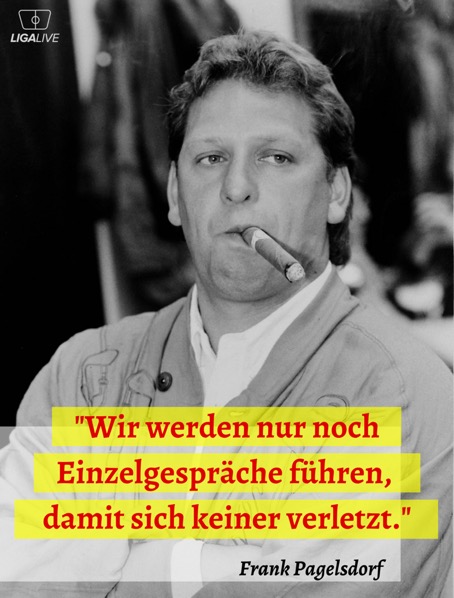
The forged bank guarantee: The biggest financial thriller involving the Köpenickers played out in the capital in 1993. Sportingly, Union Berlin had "finally" qualified for the 2. Bundesliga — 1-0 in the relegation match against Bischofswerdaer FV 08! It subsequently emerged that the bank guarantee required for licensing was forged. On July 2, 1993, the DFB awarded the second-division spot to the despised West Berlin rivals Tennis Borussia Berlin. As the Berliner Tagesspiegel later reported, an employee of Union's main sponsor allegedly tipped off TeBe's boss and hit producer Jack White (alias Horst Nußbaum). Jack White ("Heute haun' wir auf die Pauke") gratefully accepted the information. Nevertheless, it has never been definitively established who leaked this inside information to the DFB. DER SPIEGEL saw "a touch of Mielke" in July 1993 — an East Berlin football farce that Stasi boss Erich Mielke probably couldn't have staged any better: "The gentlemen of the football club Union Berlin find only short-lived comfort in the 27 verses that an 'anonymous folk poet' has nailed to the notice board at the offices in Köpenick. As in the best days of the peaceful revolution, the entire misery of the east is captured in doggerel: 'No matter how often our lads hit the net / the Wessis still do the deal!'" In any event: at the end of the 1993/94 season, Union Berlin were once again denied a second-division licence — the "lack of economic viability" hadn't changed. A debt mountain of 2.56 million euros made the DFB balk. The most valuable players, such as future World Cup runner-up Marko Rehmer and Bosnian Sergej Barbarez, had to be sold to avoid sinking even deeper into the red. Coach Frank Pagelsdorf left Berlin, joined Hansa Rostock — and won promotion to the Bundesliga with the Mecklenburg club…
Deep in trouble — The scandal professional: No other player has irked 1. FC Union more than Nico "Patsche" Patschinski. The native East Berliner apparently had a rather idiosyncratic relationship with money during his time at "Die Eisernen" from 2006, and possibly beyond. "What I do with my cash is my business. Whether I wipe my arse with it, gamble it or burn it. It's only money," he countered critics who had regarded him as a gambling addict since at least 2007. Patschinski, at 10,000 euros a month the top earner at Wuhlheide, wouldn't be Patschinski if he didn't play down the problem. "Union's sporting director Christian Beeck said in 2007 that I was addicted to gambling and sick, that I wasn't performing. By that point I'd already had myself banned from all casinos because I'd lost too much — but I wasn't a gambling addict then and I'm not now. I just played a bit of cards and placed some bets," he told the Berliner Kurier in March 2016. His participation in a charity poker tournament organised by hated East Berlin rivals BFC Dynamo earned him a formal warning and a 5,000-euro fine. Anti-Union slogans and a wild party night with Dynamo were enough for the club to dismiss Patschinski without notice for "conduct damaging to the club." When his contract was finally dissolved in July 2009 after lengthy wrangling and a severance payment of around 130,000 euros became due, Union president Dirk Zingler breathed a sigh of relief: "We're glad this chapter is closed."
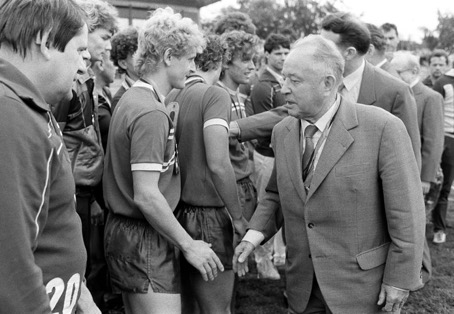
"Prague Spring" prevents European debut: Somehow, Union always had bad luck in the old days. The legendary 1968 GDR cup triumph was supposed to be followed at last by a European debut. Then the military suppression of the "Prague Spring" got in the way for the "Schlosserjungs," as the Union players were also known. The European Cup draw against the Yugoslav club FC Bor was annulled, and when the Western clubs pushed for a redraw, Dynamo Moscow — the Lev Yashin club — landed in the draw for the Berliners. Now the Eastern European clubs had had enough and withdrew their teams from the competition — the GDR followed suit. "That was of course a huge disappointment," Werner Schwenzfeier (1925–1995) recalled later. "The 15,000 tickets lasted Union as scrap paper for three years."
Fun Facts
Knowledge for blowhards, braggadocios and connoisseurs
The fact that 1. FC Union Berlin reached the 2001 DFB-Pokal final and that mascot "Ritter Keule" swings his morning star at every home game — that's fairly well known in German football. But there are plenty of lesser-known fun facts about "Die Eisernen."
The Christmas Carol Singing: It's a "Union classic" that has since been copied by numerous clubs. Semi-officially since 2003, officially since 2005, nearly 30,000 people gather at the Stadion An der Alten Försterei shortly before Christmas for the now-traditional Christmas carol singing — mulled wine included. Pastor Kastner, successor to Pastor Müller, tells the Christmas story, the choir of the Emmy-Noether-Gymnasium sets the key and tempo, and a small brass ensemble provides festive-cheerful sounds. Songbook and candle are provided free of charge — "a small donation towards the club's youth development is always welcome," the Union website notes.
Union Berlin's first European goalscorer is Sreto Ristic: The former Stuttgart player, who scored five goals in 47 Bundesliga appearances for VfB between 1996 and 2000, found the net on September 20, 2001 in the 1-1 draw at FC Haka in Finland. It paid off doubly for him, as he had a goal bonus in his contract. In the second leg, Bozidar Djurkovic, Ferdinand Chifon and Hristo Koilow scored Union's goals. They remain the club's last European goals to this day.
Berlin's largest "real football stadium": The Alte Försterei, completely rebuilt in 2008/09 and 2012/13, with a capacity of 22,012 spectators, is the largest purpose-built football stadium in the German capital (as of December 2019).
They called them Sebastian: FCU strikers Sebastian Andersson and Sebastian Polter were the most prolific scorers in the Bundesliga promotion season 2018/2019, with twelve and nine goals respectively.
Top goalkeeper: Rafal Gikiewicz — goalkeeper number one at 1. FC Union Berlin — was the best keeper of the 2018/19 2. Bundesliga season with a Kicker rating average of 2.68.
Record goalscorers: German-Algerian Karim Benyamina is the all-time top scorer at Union with 87 goals in 213 competitive appearances. He is followed by Torsten "Tusche" Mattuschka with 70 goals in 299 matches and Brazilian Daniel "Texas" Teixeira, who scored 67 goals in 78 appearances (as of December 2019).
Attendance record: Two attendances of more than 74,000 in the Berlin derbies against Hertha represented Union Berlin's record for a league match — until the Bundesliga trip to Bayern Munich on October 26, 2019 (75,000 spectators).
Record transfer: According to Transfermarkt.de, Union Berlin's most expensive departure of all time (as of December 2019) is Bobby Wood. Hamburger SV paid a club-record four million euros for the American striker in 2016. Serious money in Köpenick at the time.
Special Moments
Cup winners! But then the ban came
On June 9, 1968, one of the greatest sensations in GDR football took place at the Kurt-Wabbel-Stadion in Halle. 13,000 spectators witnessed how the freshly crowned champions FC Carl Zeiss Jena — a week after the end of the season — faced the underdog from Köpenick, 1. FC Union Berlin, in the 17th FDGB-Pokal final as overwhelming favourites. The Berliners had finished the championship 14 points behind Jena in eighth place. During the season, Jena had beaten Union 3-0 at home. In Berlin, it ended goalless.
Almost everything pointed towards Jena, for whom it was already their third FDGB-Pokal final appearance. Little pointed towards Union, who were contesting their first FDGB final. FC Carl Zeiss were particularly motivated, as they could become the first GDR team to achieve the double — champions and cup winners in one season. "Our opponents' ambition to achieve the double for the first time certainly doesn't make our task easier," Union coach Werner Schwenzfeier was quoted in the "Neue Fußballwoche."
But perhaps the Thuringians didn't take the final game of the season too seriously after all. The team was already heading to Kölpinsee on the Baltic island of Usedom just two hours after the final whistle, where family members had been gathered for days. Extra time or even a defeat were not part of the plan.
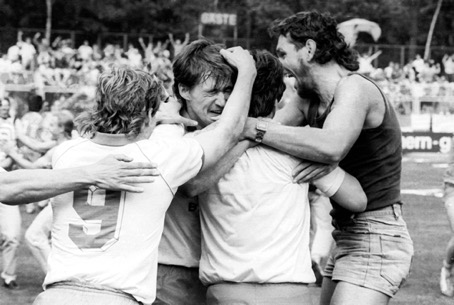
But when referee Rudi Glöckner blew the final whistle, it was the underdog from Köpenick whose players threw their arms in the air. They had beaten the Goliath from Jena 2-1 (1-1) in thoroughly deserved fashion. "The cup final was unfortunately our worst game of the season. We couldn't handle the favourite's role," Jena coach Georg Buschner explained. "On top of that, there was the lightning goal for us after 30 seconds. As bizarre as it sounds, it was poison for our team."
Werner Krauß's 1-0 was virtually the only moment that went according to plan for the champions. Union surprised everyone simply with the selection of young defender Reinhard Lauck, who just 21 days earlier had played for Energie Cottbus at Vorwärts Stralsund (1-1) on the final DDR-Liga matchday. In the quarter-final in the spring of 1968, Lauck had even played against Union. It finished 1-1 in Cottbus. Union won the replay 1-0. Lauck was actually a new signing for the 1968/69 season. The fact that he featured in the final of the preceding season is one of those curiosities of GDR football.
In the final, the relatively swift penalty equaliser from Meinhard Uentz after 29 minutes gave the underdog courage — a team that was already qualified for European competition even in the event of defeat. "FC Carl Zeiss Jena were visibly surprised by the quality of our eleven's play," Union captain Ulrich Prüfke later told the "Neue Fußballwoche." His coach Werner Schwenzfeier went further: "We dominated the champions before half-time with superior footballing means. After the break, we remained dangerous throughout with our trademark counter-attacks."
Ralf Quest scored the 2-1 after 63 minutes. Goalkeeper Rainer Ignaczak kept a clean sheet from then on. The more than 1,000 Union fans who had arrived by car and a special train enthusiastically waved their flags. The newspapers also honoured the sensation. "Crowning conclusion to a successful season" was the headline in the "Berliner Zeitung." "No dream: Union are cup winners" appeared on page 1 of the "Berliner Fußball" supplement in the "Neue Fußballwoche."
Lord Mayor Herbert Fechner presented the players at the Red Town Hall the day after the final with a Meissen porcelain plaque depicting the Red Town Hall. "We signed the 'Golden Book' of the city. Then the Lord Mayor invited us to the window," recalled the then second club secretary Günter Mielis. "In front of the Red Town Hall, a new tour bus awaited us. In large letters, the inscription 1. FC Union Berlin shone out at us."
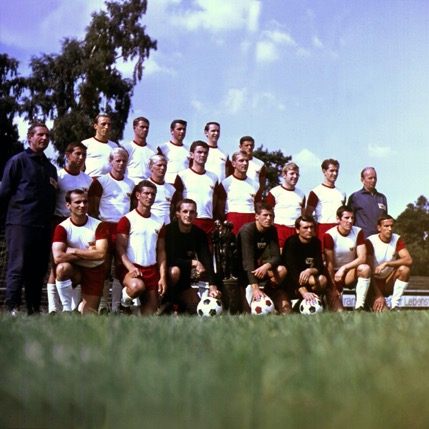
Union did not play in the European Cup despite being drawn against Yugoslav side FK Bor on July 10, 1968 in Geneva for the first round of the Cup Winners' Cup. Dark clouds gathered in the night of August 21, 1968. Around 500,000 soldiers from the Soviet Union, Poland, Hungary and Bulgaria marched into the reform-minded Czechoslovak Socialist Republic. The "Prague Spring" was ended by force of arms. In early September 1968, the political crisis also reached UEFA.
AC Milan, FC Zürich and Celtic Glasgow refused to play their initially drawn socialist opponents Levski Sofia, Dynamo Kyiv and Ferencváros Budapest in the European Cup because of the invasion by Warsaw Pact troops in Prague. UEFA's Emergency Committee consequently ordered a series of (unconstitutional) redraws in both the European Cup and the Cup Winners' Cup.
In the first round, eastern and western European clubs were to be kept apart. Champions Jena retained their draw of Red Star Belgrade; cup winners Union were now to face Dynamo Moscow. Now, in addition to the GDR's German Football Association (DFV), the football associations of the USSR, Hungary, Poland, Bulgaria and France also protested against the redraw. When UEFA stood by its revised fixtures in a further vote on September 9, 1968, the DFV Presidium threatened in a telegram on September 13, 1968 to withdraw Jena and Union. When no further response came from UEFA, the boycott of the GDR representatives was confirmed. The clubs from the Soviet Union, Hungary, Poland and Bulgaria likewise did not send their champions and cup winners.
The victory over Jena remains special despite this sore point. The significance of the triumph is all the greater given that, until 2019, it remained the only national title Union Berlin had won after the Second World War. In the days before the 2001 DFB-Pokal final between Schalke 04 and Union (2-0), the then Union president Heiner Bertram said that when looking back at Union's past, 1968 was the "only positive exception."
Wise Words
Quotes for eternity
"The crossbar must glow."
Union cult coach Werner "Schwenne" Schwenzfeier on his secret to success"The wall must go!"
Union Berlin fan(s) during free kicks in GDR times"Eisern Union only plays tin."
B.Z. newspaper"The sweet Ossis have been promoted."
ZEIT weekly newspaper"Who refuses to be bought by the West? — Eisern Union!"
Union Berlin club anthem, sung by Nina Hagen